No. 01Signature projectDocumentary, 2024
Memory Guardians
How technology can make cognitive care more human.
The project
- Made by
- Qiyuan Sun and Yiyang Xue
- Advisor
- Li Aike
- Where
- School of Television, Communication University of China
- Recognition
- Grand Prize, Beijing round, 2024 Higher Education Press Cup

Chapter 1 of 5
Chapter 01
The Human Question
Memory loss rarely happens to one person alone. When someone begins to forget, the people around them start to remember on their behalf: the appointments, the medicine, the names of the grandchildren. Memory Guardians is about that quieter, shared side of Alzheimer’s disease.
Around 51 million people worldwide live with Alzheimer’s disease, and about 10 million of them are in China.1. Figures from the condensed edition of the 2024 China Alzheimer’s Disease Blue Book, as cited in the School of Television’s article about the film. They have not been checked against the Blue Book itself for this page. We began with those numbers and then tried to look past them, through real stories and the feelings they carry, so that viewers would understand the problem and want to support the people living with it.
Chapter 02
Finding the Story
The competition asked students to tell a story about China in a foreign language, for viewers abroad. We chose a social question that aging societies everywhere share, and looked for where China’s technology companies were trying to answer it.
Our research took us to the main exhibition of Beijing Science and Technology Week, where companies and research institutes showed what they were building, including a display about digital technology for the prevention and care of Alzheimer’s disease.
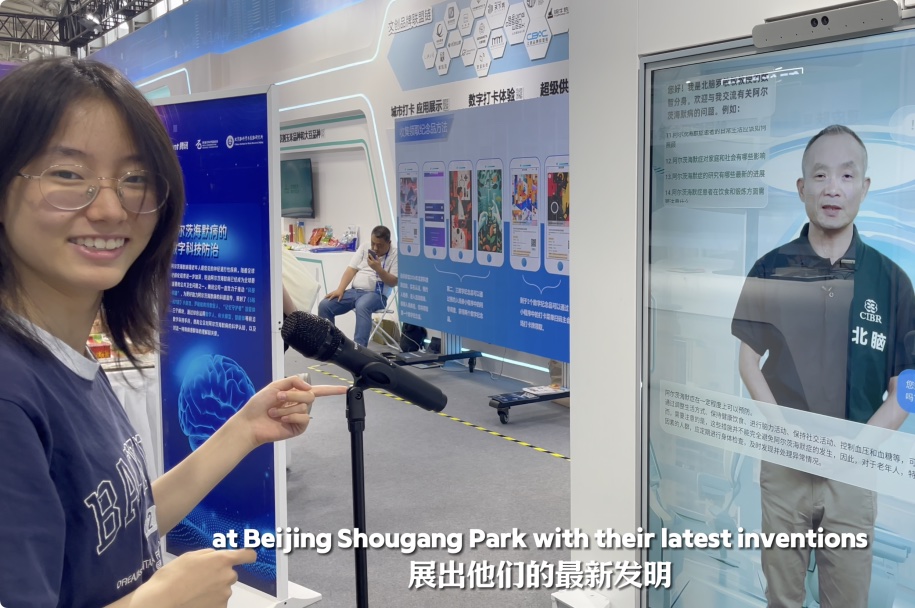
- 1. DisplayThe panel’s heading is about Alzheimer’s disease and digital technology for prevention and control.
- 2. On screenA life-size digital presenter invites visitors to ask questions about Alzheimer’s disease.
- 3. SubtitlesEnglish subtitles above Chinese: the film was made for viewers outside China.
“If it weren’t for this competition, I probably would never have known how many technology companies are working on public welfare and accessibility, taking on social responsibility through digital means.”
Chapter 03
Technology and Empathy
Our way into the subject was a small game called Building 6, Room 301, adapted by Tencent. The film looks at what it can do to teach the public about Alzheimer’s disease. On screen, the player is given ordinary tasks, the kind a person with memory loss can struggle to keep track of, such as taking the second dose of the day’s medicine at one o’clock.
Through staged, animated scenarios, the film asks how one of Tencent’s large language models might help older people and patients hold on to what they are losing, and help their families understand what is happening. We also interviewed people about the game’s effect.
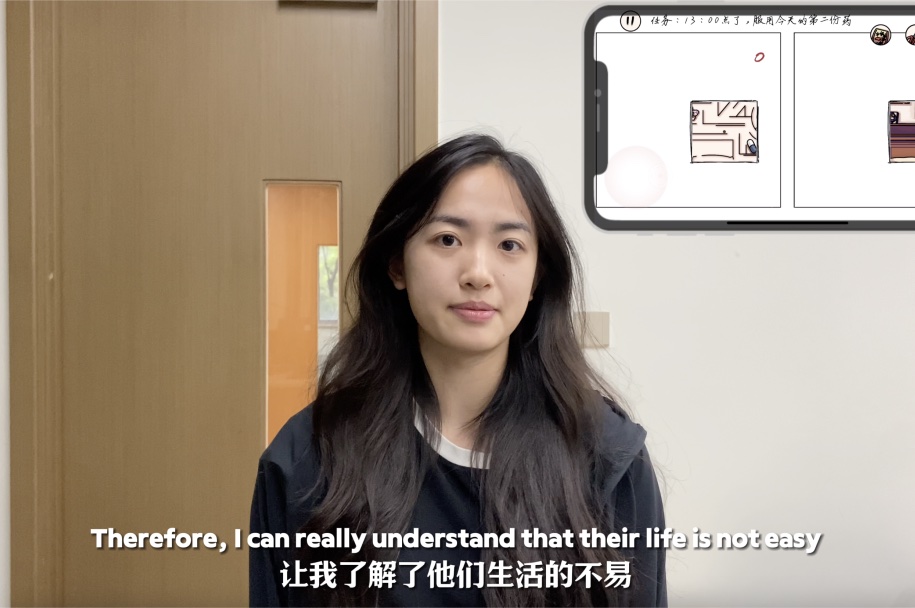
- 1. The gameThe task bar reads, roughly: “It is 13:00. Take today’s second dose of medicine.”
- 2. Subtitle“Therefore, I can really understand that their life is not easy.”
Chapter 04
The Film
The film moves between interviews, animated scenarios, screen recordings of AI tools and footage from the exhibition at Shougang Park. We filmed at the exhibition, in interviews indoors and out, and in a recording studio.
Credits, from the film
- Interviews
- Qiyuan Sun, Yiyang Xue
- Script
- Yiyang Xue
- Narration
- Yiyang Xue
- Interview voiceover
- Qiyuan Sun, Zeng Chuhan, Liao Qinsong
- Editing
- Qiyuan Sun
- Advisor
- Li Aike
- Special thanks
- A Communication University of China classmate, and staff and teams at Tencent, including Tencent Cloud, the Tencent Interactive Entertainment Social Value Exploration Center, and Tencent’s exhibition team at the 2024 Beijing Science and Technology Week.
From the production
Research notes
The exhibition
Research at the main exhibition of the 2024 Beijing Science and Technology Week. The exhibition stills place it at Beijing Shougang Park.
The game
Building 6, Room 301, a small game adapted by Tencent, used as the entry point for the film and the subject of interviews about its effect on players.
The AI scenarios
Staged scenes showing how a Tencent large language model might help older people and patients with forgetting, and help families understand the disease.
The numbers
Prevalence figures from the condensed 2024 China Alzheimer’s Disease Blue Book, as cited by the school.
Chapter 05
Recognition and Reflection
2024 · Beijing
Grand Prize
2024 Higher Education Press Cup “Telling China’s Stories in Foreign Languages” Short Video Competition for College Students, Beijing
- Organizers
- Higher Education Division of the Beijing Municipal Education Commission, with Higher Education Press
- Credited to
- Qiyuan Sun and Yiyang Xue; advisor Li Aike
- Source
- Communication University of China, School of Television: award announcement (opens in a new tab)
Making the film changed what I think technology stories are about. I went looking for products and found people: the ones who decided a game could teach empathy, the ones who sat down with us for interviews, and the families all of it is for.
It also taught me that telling a story in a second language takes more than an accurate translation. The film had to make a viewer who had never thought about Chinese families, or Chinese technology companies, care about both.
“It is because people keep speaking up for groups that society overlooks, sowing seeds of public good as best they can, that more people come to care, and society becomes warmer and more inclusive.”
The guardians in the title are not the machines. They are the people who decide what the machines are for.